

- What is the full form of GPON?GPON stands for Gigabit Passive Optical Network. It is a fiber broadband technology used to deliver high-speed internet and other services to multiple subscribers.
- What is the main difference between GPON and EPON?The main differences are their standards, transmission methods and nominal speeds. Traditional GPON supports approximately 2.5 Gbps downstream and 1.25 Gbps upstream, while traditional 1G EPON uses a 1.25 Gbps line rate in each direction.
- Is GPON faster than EPON?Traditional GPON offers higher downstream capacity than traditional 1G EPON. However, newer technologies such as 10G-EPON and XGS-PON support higher speeds.
- What is a GPON home gateway?A GPON home gateway combines optical network terminal functionality with home networking features such as routing, Ethernet ports and, in many models, Wi-Fi.
- Can GPON and EPON devices work together?Standard GPON and EPON devices generally cannot directly interoperate because they use different protocols and standards. Operators must use compatible OLT and ONT/ONU equipment.
- Which is better for FTTH: GPON or EPON?Both can support FTTH deployments. The best choice depends on required capacity, existing infrastructure, compatibility, deployment costs and future network plans.
Fiber broadband has become an essential part of modern internet infrastructure. As demand for faster internet, reliable connections and higher bandwidth continues to grow, Internet Service Providers (ISPs) and telecom operators need technologies that can support expanding networks.
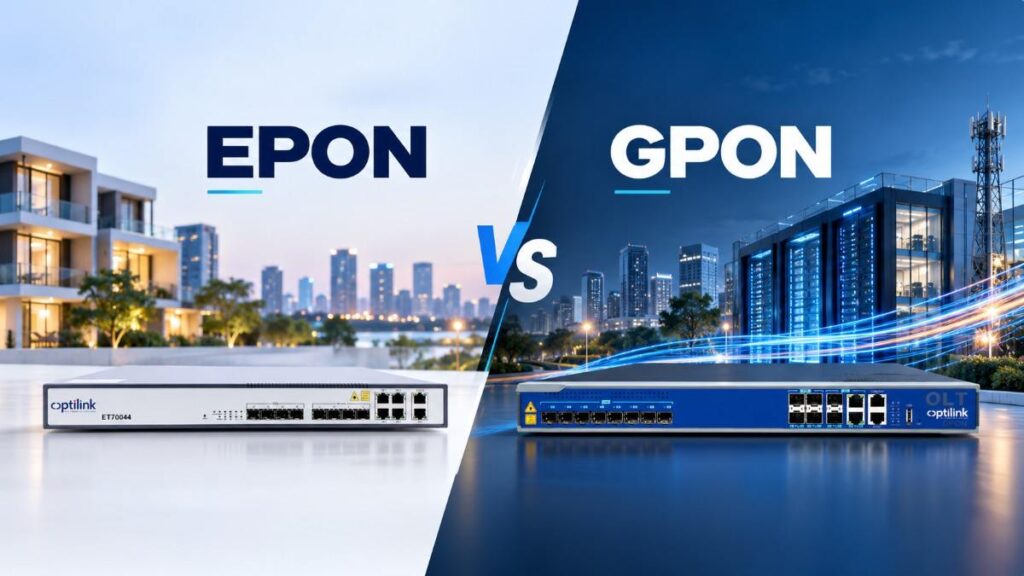
Two widely used fiber broadband technologies are GPON (Gigabit Passive Optical Network) and EPON (Ethernet Passive Optical Network).
Both technologies deliver high-speed internet over optical fiber, but they differ in speed, network architecture, bandwidth management and deployment requirements.
Understanding GPON vs EPON can help network operators choose the right technology for their broadband infrastructure.
What Is GPON?
GPON stands for Gigabit Passive Optical Network.
It is a fiber broadband technology that allows service providers to deliver high-speed internet, voice and other services to multiple users through a shared optical fiber network.
A GPON network uses passive optical splitters to distribute signals from a central location to multiple customer premises without requiring electrical power at the splitting points.
GPON is commonly used in Fiber-to-the-Home (FTTH), Fiber-to-the-Building (FTTB) and other fiber access networks.
How Does a GPON Network Work?
A typical GPON network consists of three main components:
- Optical Line Terminal (OLT): Installed at the service provider’s central office or network facility. It manages communication between the provider’s network and connected customer devices.
- Optical Distribution Network (ODN): Consists of optical fiber cables, connectors and passive splitters that distribute the optical signal to multiple locations.
- Optical Network Terminal (ONT): Installed at the customer’s premises. It receives the optical signal and provides connectivity to devices such as routers, computers and Wi-Fi equipment.
Some ONTs also include built-in Wi-Fi functionality and act as a GPON home gateway, combining fiber connectivity and home networking in one device.
Key Benefits of GPON
- High-speed fiber broadband connectivity
- Efficient bandwidth sharing among multiple users
- Support for internet, voice and video services
- Reduced need for powered equipment in the optical distribution network
- Suitable for residential and business broadband deployments
- Scalable network infrastructure for growing subscriber demand
What Is EPON?
EPON stands for Ethernet Passive Optical Network.
Like GPON, EPON uses optical fiber and passive splitters to connect multiple users to a service provider’s network.
The main difference is that EPON is based on Ethernet technology and is standardized under the IEEE 802.3 family of standards.
EPON carries Ethernet frames across the optical access network, making it suitable for service providers using Ethernet-based infrastructure.
EPON is also widely known as GEPON (Gigabit Ethernet Passive Optical Network) when referring to gigabit-class EPON deployments.
How Does an EPON Network Work?
An EPON network uses similar physical components:
- OLT: Manages the connection between the service provider and subscribers.
- Optical Distribution Network: Uses fiber cables and passive splitters to distribute signals.
- ONU/ONT: Receives the optical signal and provides connectivity at the subscriber’s premises.
EPON is commonly deployed in residential broadband networks, business connectivity and Ethernet-based access networks.
Key Benefits of EPON
- Ethernet-based network architecture
- Integration with Ethernet infrastructure
- Passive optical distribution
- Support for residential and business broadband
- Flexible deployment for service providers
- Established technology for fiber access networks
GPON vs EPON: Key Differences
Although GPON and EPON use similar fiber infrastructure, they differ in several important areas.
| Feature | GPON | EPON / GEPON |
|---|---|---|
| Full Form | Gigabit Passive Optical Network | Ethernet Passive Optical Network |
| Standard | ITU-T G.984 series | IEEE 802.3ah and related standards |
| Downstream Speed | 2.488 Gbps | 1.25 Gbps line rate |
| Upstream Speed | 1.244 Gbps | 1.25 Gbps line rate |
| Network Technology | GPON transmission and encapsulation | Ethernet-based transmission |
| Bandwidth Management | Supports dynamic bandwidth allocation | Supports dynamic bandwidth allocation |
| Common Applications | FTTH, FTTB, residential and business broadband | FTTH, Ethernet-based access and business broadband |
| Optical Distribution | Passive optical splitters | Passive optical splitters |
Note: These are nominal rates for traditional GPON and 1G EPON. Actual customer speeds depend on factors such as protocol overhead, split ratio, network configuration and service plans. Newer technologies such as XGS-PON and 10G-EPON offer higher speeds.
1. GPON vs EPON: Speed and Bandwidth
Speed is one of the main differences between traditional GPON and EPON networks.
A standard GPON connection supports approximately:
- 2.5 Gbps downstream
- 1.25 Gbps upstream
Traditional 1G EPON supports a line rate of:
- 1.25 Gbps downstream
- 1.25 Gbps upstream
However, Ethernet framing and other overhead reduce the usable data capacity.
GPON provides higher downstream capacity than traditional 1G EPON, which can be useful for broadband networks serving multiple subscribers with high download requirements.
It is important to understand that these speeds represent shared PON capacity, not guaranteed speeds for every connected subscriber.
2. GPON vs EPON: Network Architecture
Both GPON and EPON use a point-to-multipoint architecture.
This means a single OLT port can serve multiple subscribers through passive optical splitters.
The difference lies mainly in how data is transmitted and managed.
GPON uses a transmission system defined by ITU-T standards, including GPON Encapsulation Method (GEM) for carrying different types of traffic.
EPON uses Ethernet frames and IEEE-defined mechanisms for communication between the OLT and connected ONUs.
Both technologies can support efficient fiber broadband networks when designed and configured correctly.
3. GPON vs EPON: Applications
GPON and EPON are used in many similar environments, but the right choice depends on network requirements.
Common GPON Applications
Residential Broadband
GPON is widely used by ISPs to deliver high-speed internet to homes through FTTH networks.
Business Connectivity
Businesses can use GPON-based access networks for internet and other communication services.
Apartment Buildings and Housing Societies
A GPON network can distribute broadband connectivity to multiple homes through shared fiber infrastructure.
Telecom Access Networks
Telecom operators use GPON to provide fiber broadband services across residential and commercial areas.
Common EPON Applications
Ethernet-Based Broadband Networks
EPON is suitable for service providers building fiber access networks around Ethernet technology.
Residential FTTH
EPON can provide broadband connectivity to multiple households through passive fiber distribution.
Business Networks
EPON can support fiber-based connectivity in commercial environments.
Existing EPON Infrastructure
Operators with established EPON networks may prefer compatible equipment when expanding their networks.
4. What Is a GPON Router?
A GPON router is a term commonly used for a device that connects a home or business network to a GPON fiber broadband service.
Technically, the optical connection is handled by an ONT or ONU.
A device that combines GPON ONT functionality with routing and Wi-Fi features is commonly called a GPON home gateway.
Depending on the model, a GPON home gateway may offer:
- Fiber broadband connectivity
- Wi-Fi access
- Ethernet LAN ports
- Internet routing
- Network security features
- Voice connectivity on supported models
These devices help customers connect multiple devices to their fiber broadband service.
When selecting a GPON device, it is important to check compatibility with the service provider’s OLT and network configuration.
5. GPON vs EPON: Which Is Better?
There is no single technology that is best for every network.
The right choice depends on the operator’s existing infrastructure, bandwidth requirements, equipment compatibility and future expansion plans.
GPON may be a suitable choice when:
- Higher downstream capacity is required compared with traditional 1G EPON.
- The operator is building a new GPON-based FTTH network.
- The service provider needs equipment compatible with its GPON infrastructure.
- The network requires support for different broadband service types.
EPON may be a suitable choice when:
- The operator already uses EPON equipment.
- Ethernet-based integration is a priority.
- Existing infrastructure and equipment compatibility favor EPON.
- The network’s bandwidth requirements can be met by the selected EPON technology.
Both technologies can deliver reliable broadband services with appropriate equipment, network planning and maintenance.
6. What About Next-Generation PON Technologies?
Broadband networks are continuously evolving as demand for higher speeds increases.
Traditional GPON and EPON remain important, but newer technologies provide additional capacity.
XGS-PON supports nominal symmetrical speeds of approximately 10 Gbps downstream and 10 Gbps upstream.
10G-EPON offers higher-capacity Ethernet PON options, including symmetrical and asymmetrical configurations.
These technologies can help operators support higher-bandwidth services and plan future network upgrades.
However, upgrading requires compatible OLTs, ONTs or ONUs, optical components and appropriate network planning.
7. Choosing the Right GPON or EPON Equipment
Selecting the right technology is only one part of building a reliable fiber broadband network.
ISPs and telecom operators should also consider:
Equipment Compatibility
Ensure that OLTs, ONTs and other network devices are compatible with the chosen technology and required network features.
Network Capacity
Evaluate subscriber density, expected bandwidth usage and future growth.
Optical Reach and Split Ratio
Choose an appropriate fiber distribution design based on distance, optical power budget and the number of connected subscribers.
Network Management
Look for equipment that supports effective monitoring, configuration and troubleshooting.
Technical Support
Reliable technical assistance can help operators resolve issues and maintain network performance.
Optilink Networks: Broadband Solutions for Growing Networks
With more than 20 years of experience in networking technology, Optilink Networks provides broadband and optical networking solutions for ISPs, telecom operators and businesses.
Our portfolio includes GPON and other PON solutions, OLTs, ONTs, FTTH equipment, Ethernet networking products and optical transceivers.
Whether you are expanding an existing fiber network or planning a new broadband deployment, choosing the right equipment is essential for reliable performance and long-term scalability.
Explore Optilink’s broadband networking solutions or contact our team to discuss your network requirements.
Frequently Asked Questions (FAQs)
Conclusion
Understanding the differences between GPON vs EPON is important when planning or upgrading a fiber broadband network.
Both technologies use passive optical networks to deliver broadband services efficiently. GPON offers higher downstream capacity than traditional 1G EPON, while EPON provides an Ethernet-based approach to fiber access.
For ISPs and telecom operators, the right decision should be based on network requirements, equipment compatibility, bandwidth demand and long-term scalability.
Looking to build or upgrade your fiber broadband network? Explore Optilink Networks‘ GPON, FTTH and optical networking solutions.