

The internet is no longer just a service we use.
It has become the infrastructure on which businesses operate, cities function, industries innovate, and people connect.
As India moves deeper into a digital-first economy, the question is no longer simply “How fast can we connect?”
The bigger question is:
“How do we build networks that are ready for what comes next?”
India’s broadband ecosystem has already reached enormous scale, with more than 1.06 billion broadband subscribers recorded in March 2026. At the same time, the industry is moving toward AI-enabled networks, 5G expansion, future 6G technologies, cloud infrastructure, data centres and increasingly connected devices.
This transformation will change the way we think about network infrastructure.
From Connectivity to Intelligent Infrastructure
Tomorrow’s networks will need to do more than move data from one point to another.
They will need to be faster, more reliable, scalable, secure and increasingly intelligent.
AI and machine learning are already becoming part of discussions around next-generation telecom networks, including network architecture, automation and security.
This means network infrastructure will increasingly combine:
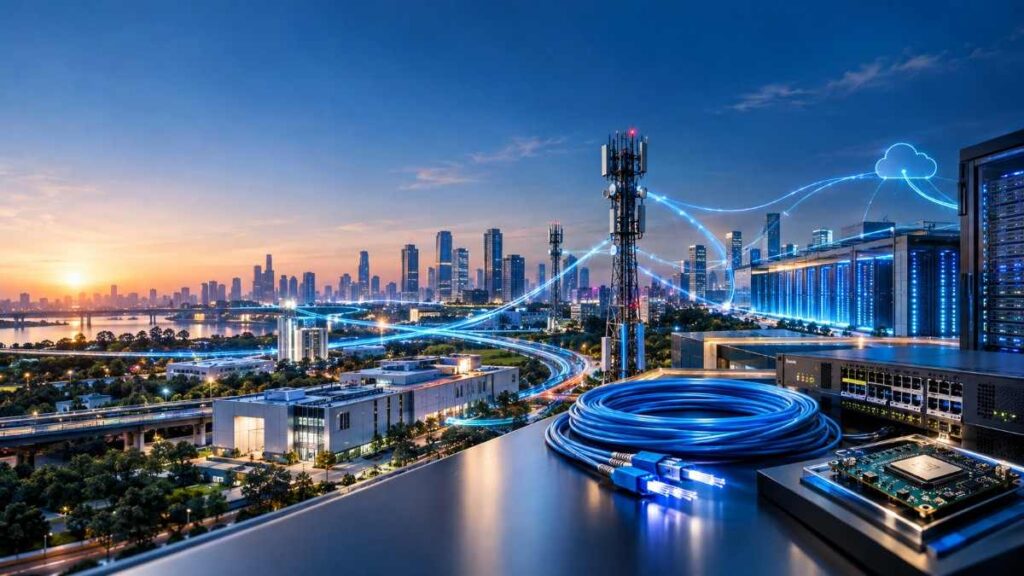
Fiber + Broadband + Software + AI + Semiconductors + Intelligent Network Management
The physical network and the software controlling it will become more closely connected.
Fiber Will Remain at the Core
As bandwidth requirements continue to grow, fiber will remain one of the foundations of digital connectivity.
From FTTH and PON networks to metro networks, data centres and high-capacity backhaul, optical infrastructure will continue to play a critical role.
The future is not about replacing fiber.
It is about making the fiber network smarter, faster and more efficient.
The Rise of Indigenous Technology
Another important shift is happening alongside the growth of connectivity: India is building greater capabilities across electronics, semiconductor design, manufacturing and telecom equipment.
Government programmes are supporting semiconductor manufacturing and design, while the broader electronics ecosystem is expanding across telecom, cloud, IoT and other strategic sectors.
This creates an opportunity for Indian companies to move beyond being users of technology and increasingly become designers, developers and manufacturers of technology.
That transition matters.
A stronger domestic ecosystem can bring together chip designers, equipment manufacturers, software developers, network operators and system integrators to create solutions designed around India’s requirements while also serving global markets.
From Hardware to Hardware + Software
The next generation of networking will not be defined by hardware alone.
Software-driven architectures can give network operators greater visibility and control over their infrastructure.
Network management, monitoring, automation, analytics and security will increasingly become part of the overall networking proposition.
The result is a shift from:
“Can we connect this network?”
to:
“Can we continuously understand, manage and improve this network?”
What Comes Next?
The future of connectivity will likely be shaped by several technologies developing together:
- Next-generation PON for higher-capacity broadband
- Fiber and optical technologies for high-speed, long-distance connectivity
- 5G and the development of 6G for increasingly connected environments
- AI-driven network management for smarter operations
- Semiconductor innovation for greater control over network hardware
- Cloud and data centres to support growing digital workloads
- Indigenous manufacturing to strengthen the technology ecosystem
These are not separate developments.
They are pieces of the same larger transformation.
Building What Comes Next
For companies operating in the networking industry, the opportunity is bigger than simply developing the next product.
It is about building the ecosystem around connectivity.
At Optilink Networks, we see the future of networking as a combination of engineering, manufacturing, software and innovation — with a strong focus on building capabilities in India.
With more than two decades of experience in networking engineering and manufacturing, we believe the next chapter of India’s connectivity story will be built through collaboration across the entire ecosystem.
Because the future of the internet will not be built by one technology.
It will be built by an ecosystem of technologies, people and companies working together.
The future is connected.
The opportunity is to build what connects it.