
- What is the full form of OLT?OLT stands for Optical Line Terminal. It is a central network device used in passive optical networks to connect service providers with multiple subscriber-side ONTs or ONUs.
- How many users can a GPON OLT support?The number of connected users depends on the number of PON ports, supported split ratio and equipment specifications. For example, an 8-port OLT using a 1:64 split ratio has a theoretical capacity of 512 optical subscriber connections, subject to hardware and network limitations.
- What is the difference between a 4-port and an 8-port GPON OLT?A 4-port GPON OLT provides four PON interfaces, while an 8-port model provides eight. An 8-port OLT can potentially serve more subscribers, assuming comparable split ratios and device capabilities.
- Which OLT is suitable for a small ISP?A smaller ISP may consider a compact 4-port or 8-port GPON OLT, depending on subscriber numbers, bandwidth requirements and expansion plans. The best choice depends on the actual network design.
- Can one GPON OLT support multiple ONTs?Yes. A GPON OLT connects to multiple ONTs through passive optical splitters. The supported number depends on port count, split ratio, optical budget and equipment limitations.
- What should I check before buying a GPON OLT?Check subscriber capacity, GPON ports, uplink speed, split ratio, optical budget, ONT compatibility, management features, reliability, technical support and total cost.
Building a reliable fiber broadband network starts with choosing the right equipment. For Internet Service Providers (ISPs), one of the most important devices is the GPON OLT (Gigabit Passive Optical Network Optical Line Terminal).
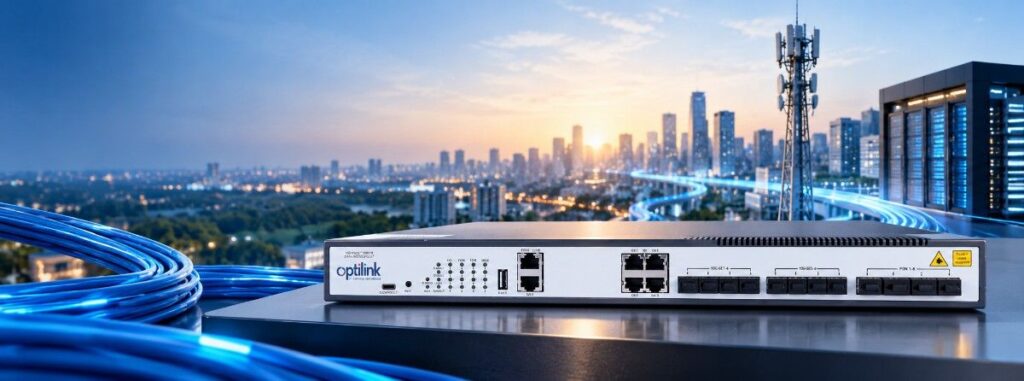
The OLT plays a central role in delivering fiber broadband services to multiple subscribers. It connects the service provider’s network to customer premises through optical fiber and helps manage data transmission, bandwidth allocation and subscriber connectivity.
Choosing the right GPON OLT is not simply about selecting a device with more ports. ISPs must consider network size, subscriber capacity, uplink bandwidth, equipment compatibility, network management and future expansion.
This guide explains how to choose an OLT that meets your current network requirements while supporting long-term growth.
What Is a GPON OLT and How Does It Work?
An OLT (Optical Line Terminal) is a network device installed at an ISP’s central office, point of presence (PoP) or network distribution facility.
It acts as the central connection point between the service provider’s network and multiple customer-side Optical Network Terminals (ONTs) or Optical Network Units (ONUs).
A typical GPON network consists of three main components:
- OLT: Manages communication, subscriber access and bandwidth allocation.
- Optical Distribution Network (ODN): Uses fiber cables and passive optical splitters to distribute signals.
- ONT/ONU: Receives the optical signal at the customer’s location and provides connectivity to their network devices.
A GPON OLT supports nominal line rates of approximately 2.5 Gbps downstream and 1.25 Gbps upstream per GPON port. This capacity is shared among the subscribers connected to that port.
The right OLT helps an ISP manage this shared capacity efficiently and deliver consistent broadband services.
1. Understand Your Network and Subscriber Requirements
Before selecting an OLT, determine how many subscribers your network needs to support.
For example, an ISP planning to connect 200 homes will have different equipment requirements from an operator planning to serve 2,000 subscribers.
Start by evaluating:
- Number of existing subscribers
- Expected subscriber growth
- Residential or business customer requirements
- Internet plans and bandwidth demand
- Geographic coverage and fiber distribution design
- Future network expansion plans
For a growing ISP, selecting equipment based only on current demand may lead to additional hardware investment sooner than expected.
Recommendation: Estimate your subscriber requirements for the next two to three years and choose an OLT that provides sufficient capacity and expansion options.
2. Choose the Right OLT Port Capacity
One of the most important factors when selecting a GPON OLT is the number of PON ports.
Each GPON port can connect to multiple ONTs or ONUs through passive optical splitters.
Common OLT configurations include 4-port, 8-port and 16-port models, although other configurations are available.
How Many Subscribers Can an OLT Support?
The theoretical number of connected subscribers depends on the number of PON ports and the supported split ratio.
| GPON Ports | At 1:32 Split Ratio | At 1:64 Split Ratio |
|---|---|---|
| 4 Ports | 128 ONTs | 256 ONTs |
| 8 Ports | 256 ONTs | 512 ONTs |
| 16 Ports | 512 ONTs | 1,024 ONTs |
These figures illustrate the number of possible optical connections, not guaranteed supported subscribers or performance. Actual capacity depends on the OLT model, optical budget, supported ONT limits, service configuration and bandwidth requirements.
For example, an ISP planning to connect 300 subscribers could consider an 8-port GPON OLT with an appropriate split ratio and capacity for future growth.
However, the operator must also consider bandwidth sharing and peak-hour traffic.
Key takeaway: Choose OLT port capacity based on subscriber demand, network design and available bandwidth—not only the maximum number of ONTs that can be connected.
3. Check the Split Ratio and Optical Power Budget
The split ratio determines how many subscribers can share a single GPON port.
Common split ratios include:
- 1:16: Up to 16 subscriber connections
- 1:32: Up to 32 subscriber connections
- 1:64: Up to 64 subscriber connections
- 1:128: Up to 128 subscriber connections, where supported
A higher split ratio can reduce the number of OLT ports required, but it also increases optical splitting loss and the number of subscribers sharing bandwidth.
For example, a 1:64 split allows more ONTs to share a GPON port than a 1:32 split, but the available bandwidth must serve more subscribers.
Why Does the Optical Power Budget Matter?
The optical power budget determines how much signal loss the connection can tolerate between the OLT and ONT.
It must account for:
- Fiber cable length
- Passive splitter losses
- Connectors and splices
- Other optical losses
- Appropriate engineering margin
The selected optical modules, OLT and ONTs must support the planned network design.
Recommendation: Calculate the optical power budget before finalizing the split ratio or equipment selection.
4. Evaluate Uplink Speed and Bandwidth
While GPON ports connect subscribers to the access network, uplink ports connect the OLT to the ISP’s aggregation or core network.
Depending on the model, an OLT may offer Gigabit Ethernet, 10 Gigabit Ethernet or other uplink interfaces.
For example, an OLT with multiple GPON ports can have several gigabits of combined downstream line capacity. If its uplink bandwidth is insufficient, congestion may occur during periods of heavy network usage.
When evaluating uplink capacity, consider:
- Number of active subscribers
- Internet plan speeds
- Peak-hour traffic
- Expected bandwidth growth
- Available uplink interfaces
- Link aggregation and redundancy support
An ISP offering higher-speed broadband plans should ensure the OLT’s uplink capacity can support expected traffic demand.
Key takeaway: A high-capacity GPON OLT should be supported by adequate uplink bandwidth and a properly designed aggregation network.
5. Check ONT and ONU Compatibility
A GPON network requires compatible equipment at both ends of the optical connection.
The OLT communicates with ONTs and ONUs to establish connections, configure services and manage subscriber traffic.
Although GPON equipment follows standards such as ITU-T G.984 and G.988, interoperability between devices from different manufacturers should not be assumed.
Some advanced features, configuration methods and management functions may differ between vendors.
Before selecting an OLT, check:
- Supported ONT and ONU models
- GPON standards compliance
- Service provisioning capabilities
- VLAN and QoS support
- Firmware compatibility
- Third-party interoperability testing
For ISPs operating networks with equipment from multiple vendors, interoperability testing is particularly important.
Recommendation: Test the intended OLT and ONT combination before large-scale deployment.
6. Look for Network Management Features
As the number of subscribers increases, managing a broadband network becomes more complex.
An OLT should provide tools that help operators configure services, monitor network performance and troubleshoot connectivity issues.
Important management capabilities may include:
Subscriber Management
Provision, configure and monitor connected ONTs and ONUs.
Bandwidth Management
Allocate bandwidth based on subscriber requirements and service plans.
VLAN and QoS Configuration
Manage network segmentation and prioritize different types of traffic.
Fault Monitoring
Identify alarms, connectivity failures and optical signal issues.
Remote Management
Allow authorized administrators to monitor and manage network equipment without visiting every installation site.
When evaluating an OLT, ISPs should also check whether it supports integration with their existing network management systems.
Effective management can reduce troubleshooting time and simplify daily network operations.
7. Consider Reliability and Network Security
Broadband networks must remain available to customers throughout the day.
An unreliable OLT can affect multiple subscribers connected to the same equipment.
When selecting an OLT for an ISP network, consider:
- Hardware reliability and operating conditions
- Power supply options and redundancy, where available
- Firmware updates and maintenance support
- Secure administrator access
- User authentication and access controls
- Network monitoring and alarm management
- Vendor support and replacement availability
Security should also be part of the selection process.
ISPs should evaluate device access controls, firmware maintenance practices and management interface security before deployment.
Choosing equipment with suitable reliability and security capabilities can help reduce operational risks.
8. Plan for Future Network Expansion
Broadband demand continues to grow as more households and businesses rely on fiber connectivity.
An OLT that meets today’s requirements may not provide sufficient capacity as subscriber numbers increase.
Before purchasing equipment, ask:
- Can additional PON ports be added or deployed easily?
- Does the equipment support the required uplink capacity?
- Can it integrate with the existing network infrastructure?
- Is remote management available?
- Can the network support future broadband upgrades?
Operators should also consider the long-term technology roadmap.
For example, networks that may require higher capacity in the future could evaluate migration options involving XGS-PON.
However, upgrading from GPON to XGS-PON requires compatible equipment and careful network planning.
Recommendation: Choose an OLT that supports your realistic growth requirements rather than investing only for the current subscriber count.
9. Evaluate Total Cost of Ownership
OLT pricing is an important consideration, especially for ISPs deploying networks across multiple locations.
However, the lowest initial purchase price does not always result in the lowest long-term cost.
When evaluating the cost of an OLT, consider:
- Initial equipment purchase
- Optical modules and accessories
- Installation and configuration
- Network management software or licensing
- Power consumption
- Maintenance and technical support
- Expansion and replacement costs
For example, an OLT with better management capabilities may reduce operational effort, while a suitable port configuration may limit the need for additional hardware.
The goal is to select equipment that provides the right balance of performance, reliability, support and cost.
10. GPON OLT Selection Checklist for ISPs
Before finalizing an OLT, use this checklist to evaluate whether the equipment meets your requirements.
| Selection Criteria | What to Check |
|---|---|
| Subscriber Capacity | Current and projected subscriber numbers |
| PON Ports | Number of GPON ports required |
| Split Ratio | 1:16, 1:32, 1:64 or other supported configurations |
| Optical Budget | Fiber distance, splitters and optical losses |
| Uplink Capacity | GE, 10GE or other required interfaces |
| ONT Compatibility | Supported models and interoperability |
| Network Management | Provisioning, monitoring, VLANs, QoS and alarms |
| Reliability | Power, hardware quality and maintenance support |
| Security | Access controls and firmware support |
| Scalability | Expansion options and future network plans |
| Technical Support | Availability of assistance and replacement services |
| Total Cost | Purchase, deployment and operating expenses |
Using a structured checklist helps ISPs compare equipment based on operational needs rather than specifications alone.
Optilink Networks: GPON Solutions for ISP Networks
With over 20 years of experience in networking technology, Optilink Networks provides broadband and optical networking solutions designed to support growing network infrastructure.
Our portfolio includes GPON OLTs, ONTs, FTTH equipment, Ethernet networking products and optical transceivers.
For ISPs planning new deployments or network expansion, selecting the right combination of equipment is essential for reliable connectivity, efficient management and long-term scalability.
Whether you are connecting a new residential area or expanding an existing broadband network, Optilink can help you explore equipment options based on your requirements.
Explore Optilink’s GPON OLT range or contact our team to discuss your network requirements and request a quotation.
Frequently Asked Questions
Conclusion
Choosing the right GPON OLT is an important decision for any ISP building or expanding a fiber broadband network.
The ideal OLT should meet current subscriber requirements while providing sufficient bandwidth, reliable connectivity, effective network management and room for future growth.
Rather than focusing only on price or port count, ISPs should evaluate the complete network design and long-term operational requirements.
Planning to build or expand your ISP network? Explore Optilink Networks‘ GPON OLT solutions and connect with our team to find the right equipment for your deployment.